
Diagnosing Nitrogen Consumption and Oxygen PPM Issues in Reflow Soldering
Overview
A high‑volume electronics manufacturer contacted Solderstar after experiencing inconsistent soldering quality, despite their reflow oven reporting oxygen levels that appeared to be within specification. The oven’s built‑in monitor consistently displayed readings around 900 ppm, suggesting that the nitrogen environment was stable. However, oxidation‑related defects on assemblies indicated that parts of the process were being exposed to far higher oxygen levels than the machine reported.
To uncover the discrepancy, the manufacturer turned to Solderstar’s real‑time pass‑through diagnostic technology.
The Challenge
A controlled nitrogen atmosphere is essential for achieving consistent soldering results, especially in high‑volume production. When the customer began seeing oxidation indicators and soldering defects, several concerns emerged:
- Potential malfunction of the oven’s oxygen monitoring system
- Excessive nitrogen consumption without corresponding process stability
- Risk of hidden oxygen ingress in specific oven zones
- Reduced confidence in the accuracy of machine‑reported data
Because the oven’s fixed sensor continued to show acceptable ppm levels, the root cause was not immediately obvious.
Using Pass‑Through Diagnostics for True Process Measurement
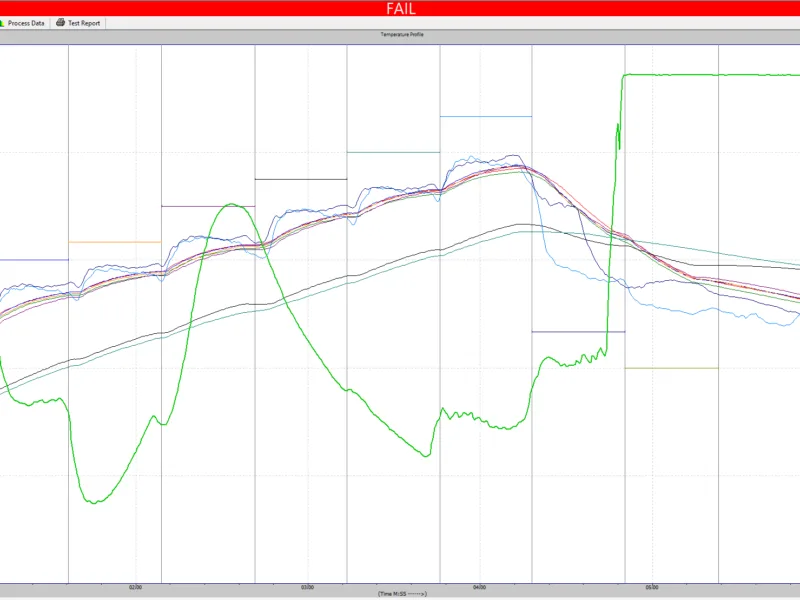
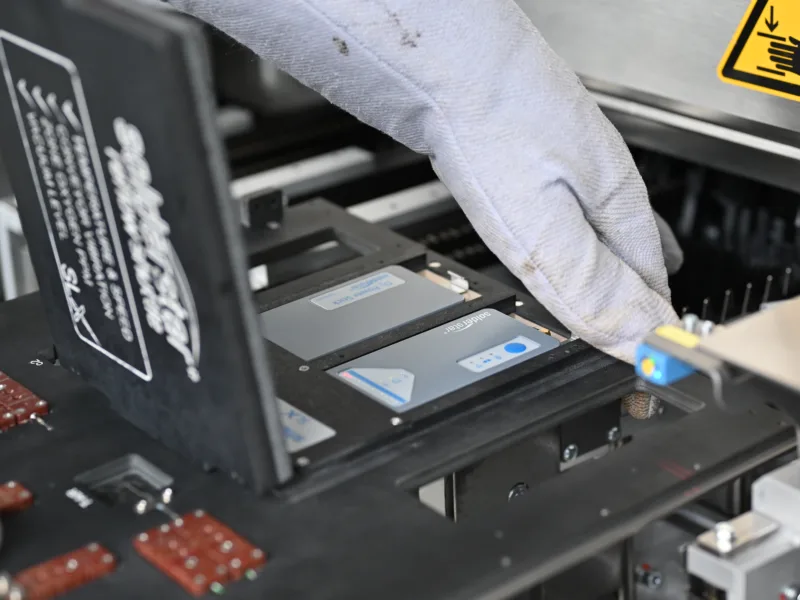
To investigate further, the engineering team deployed the Reflow Shuttle pass‑through profiling system. Unlike fixed‑point sensors, the Shuttle measures oxygen dynamically as it travels through each zone of the oven, providing a complete picture of the actual process environment.
The results were striking. While the oven’s display continued to show ~900 ppm, the Shuttle recorded oxygen levels exceeding 10,000 ppm in several zones—far above the acceptable process window. This confirmed that the built‑in monitor was only capturing conditions in a single, well‑purged area of the oven, not the full conveyor path.
Identifying the Root Cause
With the discrepancy confirmed, the investigation shifted to the oven’s nitrogen distribution system. A detailed inspection revealed that sections of the internal nitrogen pipework had been incorrectly connected. Although nitrogen was being supplied at multiple inlet points, the internal piping was not properly linked across all zones.
As a result:
- Some zones received adequate nitrogen flow
- Others received little to none
- The oven’s fixed oxygen sensor was positioned in a correctly purged zone, giving operators a misleading sense of stability
This misconfiguration led to both excessive nitrogen consumption and uncontrolled oxygen exposure in critical areas of the process.
Corrective Action & Results
The nitrogen distribution system was reconfigured to ensure proper linkage across all oven zones. Once the pipework was corrected, the line was re‑profiled using Solderstar’s process verification tools to confirm uniform nitrogen coverage. The follow‑up measurements showed consistent low‑oxygen conditions throughout the entire length of the oven.
With stable nitrogen distribution restored, soldering quality improved immediately. Oxidation‑related defects were eliminated, nitrogen usage decreased due to more efficient purging and operators regained confidence in the accuracy of the process environment. The manufacturer also implemented routine pass‑through oxygen checks to prevent future discrepancies.
Conclusion
This case demonstrates the limitations of relying solely on fixed‑point machine instrumentation for atmosphere‑critical processes. By using Solderstar’s pass‑through diagnostic technology, the manufacturer uncovered a hidden nitrogen distribution fault that would have remained undetected through standard monitoring.
The result was a fully restored low‑oxygen environment, improved soldering consistency, and reduced nitrogen waste—reinforcing the value of real‑process measurement across the entire oven path.
If you’d like to explore how multi‑parameter verification can help diagnose hidden atmosphere issues, you can learn more about thermal profiling solutions or speak with our team about your application.
